














West Virginia Explorer - A guide to whitewater rafting, hiking, biking, fishing, hunting, skiing, travel and history and culture in WV

2005-2006
 West Virginia
Ski Season

West Virginia Skiing


Home \ Recreation \ Whitewater Rafting \ WV Whitewater Rivers


West Virginia
Whitewater Rivers

More than 20 whitewater rafting outfitters and guide companies are  licensed to operate on nine West Virginia whitewater rivers, including the "Big Three" that have won the Mountain State world fame as a whitewater rafting destination -- the New River, the Gauley River, and the Cheat River. The  preview information of West Virginia's whitewater rivers will expand soon to include detailed surveys of each

West Virginia whitewater rafting rivers map
Big Sandy River
Renown for its waterfalls and sudden plummets, the Big Sandy River, a tributary of the Cheat, yields a temperamental high-water run on Class III and IV whitewater rapids.


Cheat River
The remote, boulder-strewn canyon of the Cheat River can be leisurely and lonely or raucous and raging. Spring thaws create highly technical Class III-to-V+ rapids recommended for experienced whitewater rafters. The remote nature of this 12-mile, boulder-filled river canyon makes it a special treat. More than 30 whitewater rapids -- with names such as "Decision," "Big Nasty," "Even Nastier," and "High Falls" -- are best challenged April through early June.


Gauley River

Dropping more than 668 feet through a 28-miles gorge, the Gauley River features more than 100 white water rapids with huge waves, steep gradients, and technical runs. Its challenging rapids and scenic beauty have earned it the rank of the world's seventh most popular whitewater river. The upper Gauley features Class III to V+ drops through steep, turbulent chutes and rocky routes that demand constant maneuvering. This section requires experience, and rafter must be 16 or older. The lower, 12-mile stretch includes Class III-to-V rapids, and rafters must 12-to-14, depending upon the outfitter. The lower Gauley is often run as a warm-up for a day on the upper section. The Gauley rages for 20 days in autumn, during "Gauley Season" when Summersville Reservoir is lowered to accommodate snowmelt. Because of limited space and intense popularity, reservations must book quickly.

Latest streamflow and elevation data for the Gauley River via the U.S. Army Corps of Engineers' The Whitewater Pages   (opens in new Browser window.)

Latest Gauley River levels & streamflow conditions from WVa Whitewater (opens in new Browser window.)


Meadow River -- Bluestone River

Runnable only when swollen by spring rains, both rivers provide Class III to V white water rapids within nationally protected West Virginia mountain gorges. The Bluestone River, in Bluestone Country, feeds into the New River at Bluestone Lake. The Meadow River, in Whitewater Country, feeds into the Gauley.

Latest streamflow and elevation data via the U.S. Army Corps of Engineers' The Whitewater Pages (opens in new Browser window.)


New River

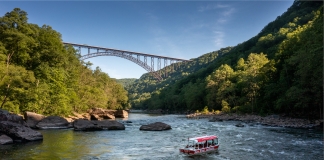
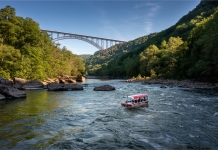
A contradiction in terms, the New River is the oldest river in the western hemisphere. From the summits of the Blue Ridge in North Carolina, it meanders north, gaining in volume and velocity, until entering the New River Gorge as the New River Gorge National River, part of the national park system. One of the most spectacular canyons in the east, its depth ranges from 700 to 1,300 feet. Herein, the river drops 240 feet over a 14-mile stretch of Class I-to-V rapids. Outfitters and guides generally divide the New River into three sections -- the upper lends itself to leisurely float fishing trips, the middle offers moderate rapids suited for novices (Class II and III), the raging lower boasts roaring Class II-to-V whitewater rapids. Favorite whitewater rapids include "Surprise," "Double Z," "Miller's Folly," and "Thread the Needle." Other favorite whitewater spots include "Swimmer's Rapid" and "Jump Rock."

Latest streamflow and elevation data for New River via the U.S. Army Corps of Engineers' The Whitewater Pages   (opens in new Browser window.) 

Latest New Rivers levels & streamflow conditions from WVa Whitewater (opens in new Browser window.)


North Branch of the Potomac River
When water is released from Jennings Randolph Lake, the North Branch becomes another of West Virginia's most-challenging spring runs. It rages along the Maryland border above the West Virginia eastern panhandle in the Potomac Branches region.


Shenandoah River
Upstream of its junction with the Potomac River in the Harpers Ferry National Historic District, the Shenandoah River flows through one of the most beautiful of American landscapes -- the Great Valley of Virginia. Its most frequently rafted stretch begins above Harpers Ferry with Class I riffles before descending the Class III "Staircase." This West Virginia whitewater river is ideal for families, winding among historic towns only two hours west of Washington, D.C.


Tygart River
Though ranked among the mightiest of mountain rivers, The Tygart River is rarely crowded. White water rapids range from Class I to V and include "Wells Falls," the most powerful, runable drop in the Monongahela River Basin. "Valley Falls," offers a short-but-intense 25-foot slide. High water runs in spring are often combined with a day on the Cheat. Whitewater rafters on this West Virginia river must be at least 12.


Top of Page


Copyright © 1999-2005 by WVExplorer.com - All Rights Reserved

WVExplorer.com and West Virginia Explorer are Trademarks of Sibray and Associates.

West Virginia Explorer's Privacy Statement

Contact: West Virginia Explorer